Taxes included.
The first time a child finds the Moon in an eyepiece, they tend to go quiet for a moment. Then they want everyone else to look. This 70mm refractor is a beginner telescope for kids and families.
It shows the Moon’s craters, mountains and dark “seas” in clear detail, and it comes with everything you need to start on the first clear night.
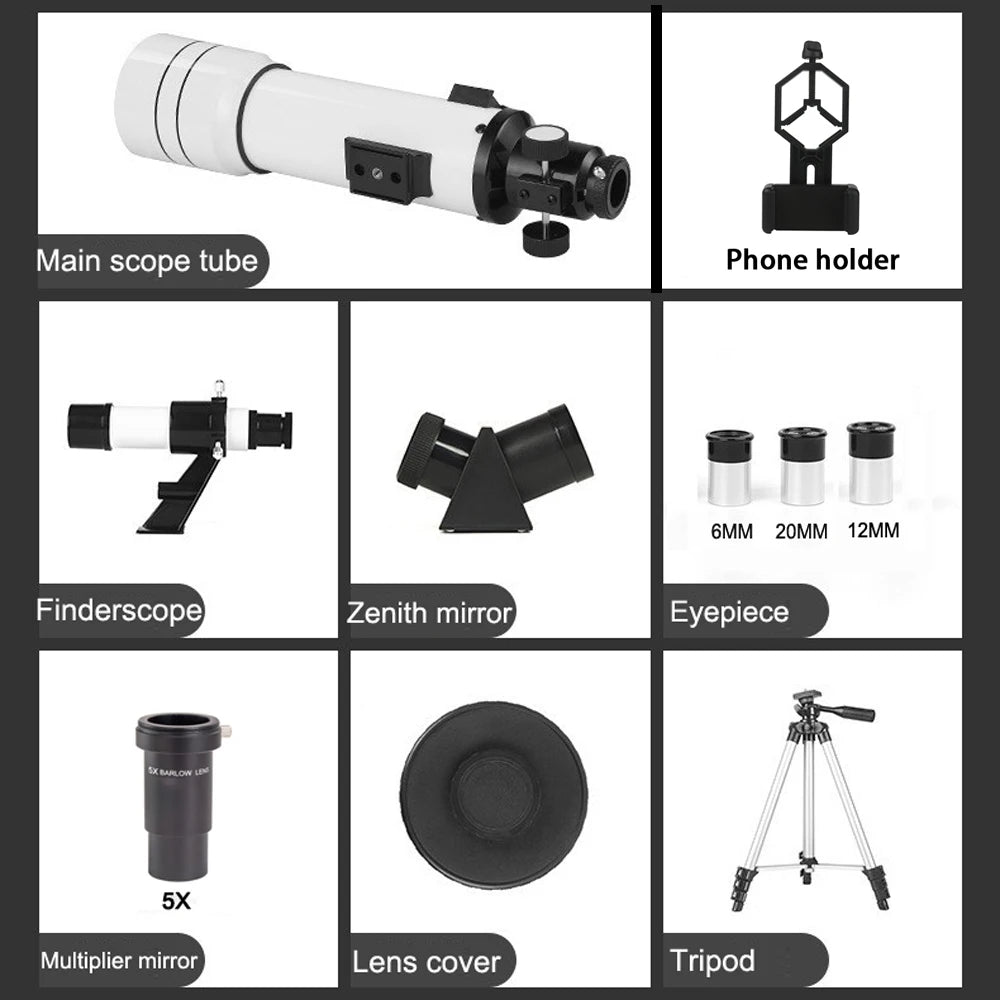
Three eyepieces, a Barlow lens, a Moon filter, a phone clip for photos, and an aluminium tripod are all in the box. No batteries, no app, nothing else to buy.
What can you see with a 70mm telescope?
With a 70mm telescope you can see craters and mountain ranges on the Moon, Saturn’s rings, Jupiter’s four largest moons and the phases of Venus. The Moon is the highlight. At 33x or 66x, the craters along the line between light and shadow look almost three-dimensional, and most children want to go back to them night after night.
Planets look small but real. Saturn appears as a tiny, crisp ring around a bright dot. Jupiter shows its moons lined up beside it, in a different arrangement each night. Star clusters like the Pleiades fill the view with dozens of stars. Galaxies and nebulae show up as faint grey glows rather than the coloured images you see in photographs, so it’s worth telling a child that before the first night out.
It works in daylight too, for boats on the horizon, a distant church tower or birds in a far-off tree.
Which magnification should you use?
Start with the 20mm eyepiece. It gives 20x and shows the whole Moon at once, which makes finding things easy. Once something is centred, switch to the 12mm (33x) or the 6mm (66x) for a closer view. The 5x Barlow lens multiplies each eyepiece, giving 100x, 166x and 333x.
Here’s the honest picture on the high numbers. A 70mm lens gives its sharpest views up to about 100x to 140x. The 166x and 333x settings work, but the image becomes dimmer and softer, so your best views will be between 20x and 100x. That’s true of every telescope this size, whatever the box says.
Who is this telescope right for?
It suits children from about 8 years old, with an adult helping for the first few sessions. Most children from around 12 can set it up and use it on their own. It also works well as a first telescope for an adult who wants to see the Moon and planets before spending on a larger instrument.
If the child already has a toy telescope, this is a real step up. A 70mm lens collects about three times as much light as a 40mm toy telescope. That’s the difference between a blurry white disc and a Moon covered in craters.